Hanwha Ocean 2026 AX·AI Development (DT): An Additional-Offer Retrospective
Loading comments...
Loading comments...
After finishing my Hanwha Aerospace internship, I applied for Hanwha Ocean's 2026 new-grad AX·AI Development (DT) role. I went from document screening to a video 1st interview and an in-person executive 2nd interview, but the 2nd-round result was a waitlist (additional-offer candidate). Today, that waitlist converted into an additional offer.
This is a step-by-step retrospective of the whole process, mostly for my future self.
My cover letter focused on extending the field data → real-time monitoring experience from my Hanwha Aerospace internship into Hanwha Ocean's complex industrial AX problems (shipbuilding, offshore, defense, energy plants). Rather than raw model performance, I emphasized the ability to turn data into decision criteria the field can actually use.
The initially assigned division was Offshore, and the interview format was a 1-applicant : many-interviewers video interview.
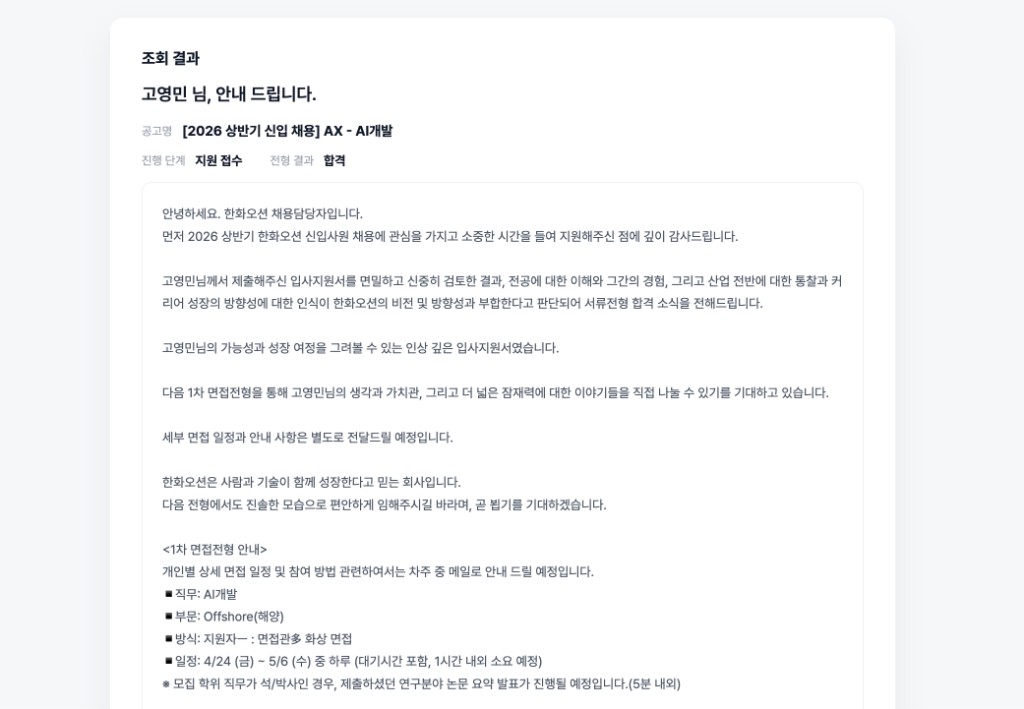
Document screening pass: Offshore division, video 1st interview
The first round was a video interview centered on motivation, role understanding, and project-based questions. The key was consistently connecting my UGV-MON (UGV communication monitoring) internship experience to the shipbuilding/offshore domain.
I passed. Interestingly, the 2nd-round notice reassigned the division to Energy Plant Unit (EPU) with an in-person executive interview format.
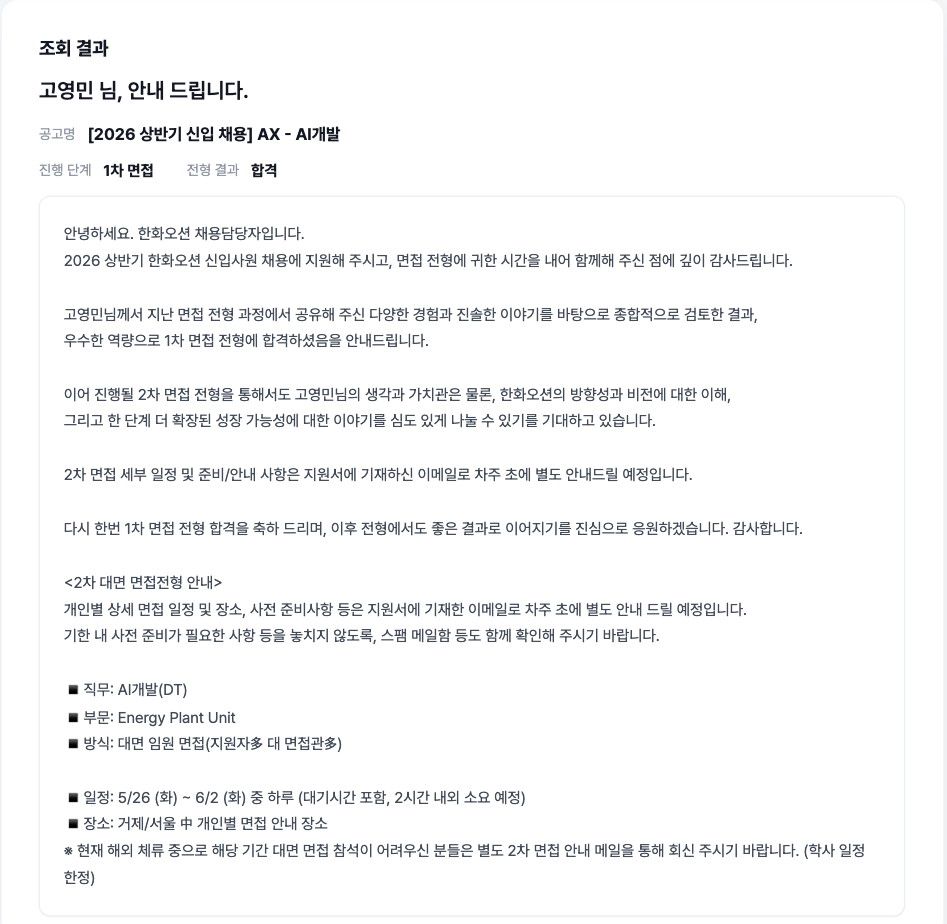
1st interview pass: 2nd round is an in-person EPU executive interview
The second round was an in-person, many-to-many executive interview held in Geoje/Seoul. I judged that executive interviews look at role fit, organizational fit, and structure of speech more than technical depth, so I first locked down three sentences any question would circle back to:
I grouped my answers along these axes (only partially summarized here):
Q. Motivation: why Hanwha Ocean?
: Beyond ordinary manufacturing, it's a complex field where shipbuilding, offshore, defense, and energy plants move together. Aiming to be a Global Ocean Solution Provider, with the scope widening through EPU integration and the US Navy MRO business; in that context, the AX ability to turn field data into operational decision criteria matters.
Q. How do you understand EPU/Offshore?
: EPU is the energy-plant division formed by integrating the former offshore division and the E&I unit; Offshore centers on FPSO, FLNG, Drillship, offshore platforms, and WTIV. Because design, procurement, production, quality, and schedule data are all linked, AI Development (DT) is about connecting scattered data flows and risk indicators into a form the field can judge.
Q. Explain UGV-MON to an executive, simply.
: A real-time monitoring project that lets people quickly judge UGV communication status. At first I thought showing logs well was the point, but defining which signals actually mean danger mattered more. Field AI needs a stable data flow and judgment criteria first.
Q. Recent AI Agent experience?
: In a personal service project, I used an AI coding agent to check issues scattered across files: Firebase permissions, ops settings, a readiness check. I defined the problem and the validation criteria; the agent handled exploration and suggested edits; I verified the final result via diffs and logs (emphasizing permissions, evidence, validation, and a human-in-the-loop final check).
Q. Strengths and weaknesses?
: My strength is a stubbornness for tracing root causes. In LG Aimers, when the score was lower than expected, I didn't just swap models; I re-examined the metric (SMAPE) and data distribution, then tuned post-processing and ensembling to get results. My weakness is a tendency to dig alone early on, which I offset by asking questions and sharing progress faster.
The 2nd-round result was neither pass nor fail: a waitlist. Precisely, I was selected as an "additional-offer candidate" considering further selection, with the final review to be communicated sequentially by June 22.
Honestly, this was the most unsettling stage. Not rejected, but not accepted: an uncontrollable wait.
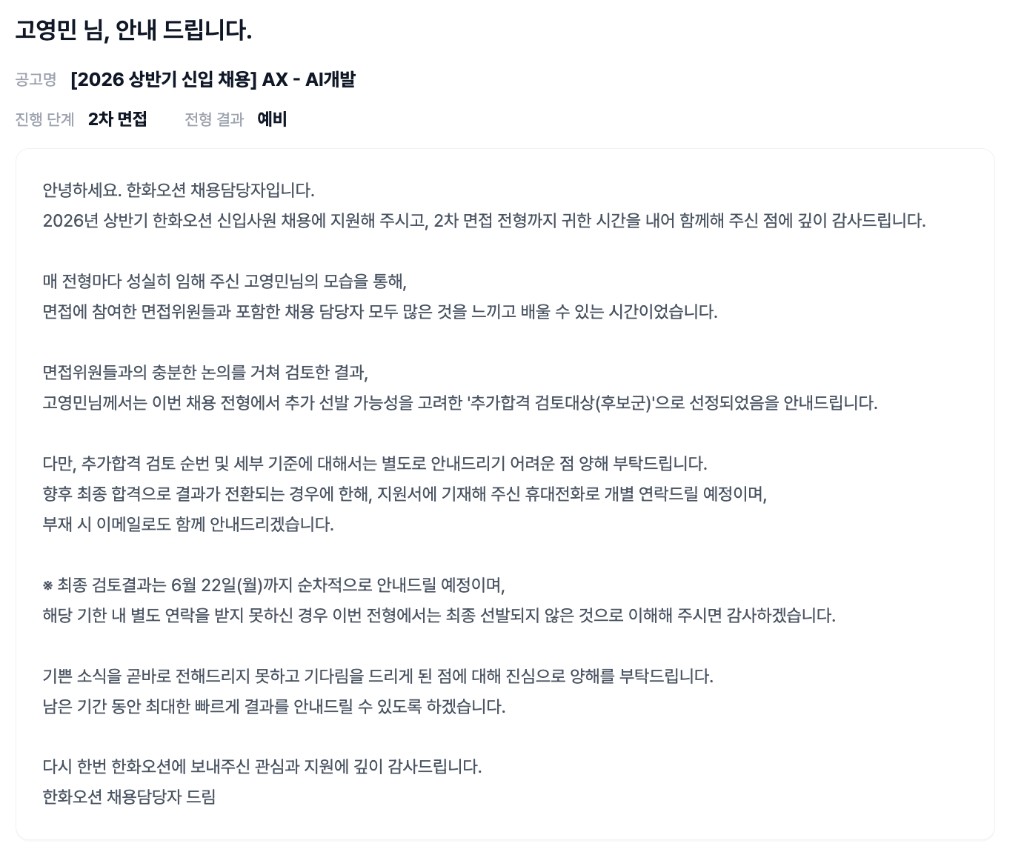
2nd interview result: "waitlist," selected as an additional-offer candidate
Around the announced deadline, an email arrived from Hanwha Ocean's talent acquisition team. Regarding additional-offer adjustments, they had tried to call three times without reaching me, so they emailed instead. If I didn't confirm my intent to join by the deadline, it would be treated as no intent.
(Missing those calls was a close call. During hiring season, always answer unknown numbers.)
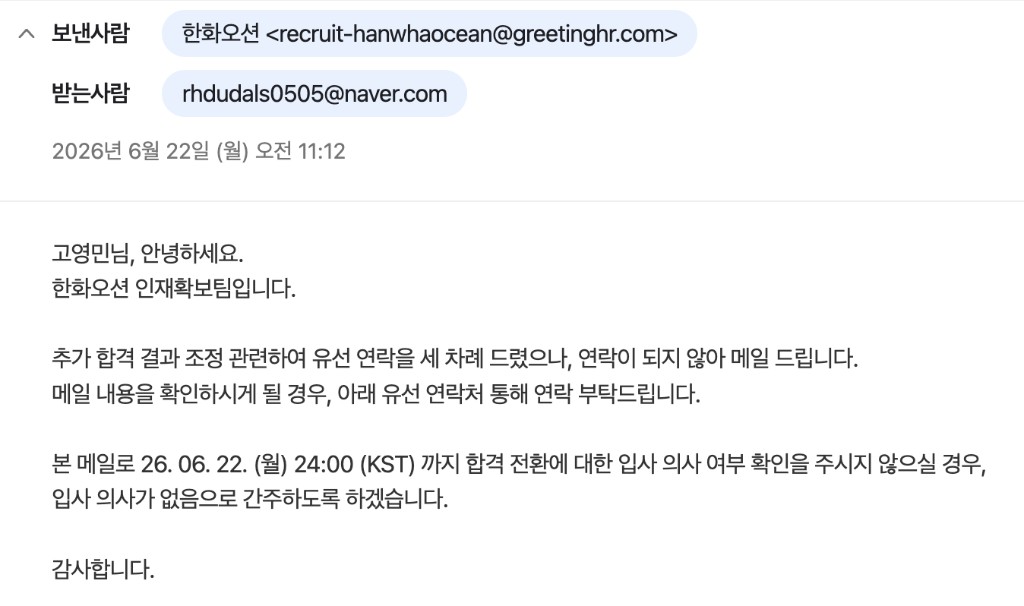
Email from Hanwha Ocean's talent acquisition team on the additional-offer adjustment
From waitlist to additional offer. Division EPU, team AI Development (DT) Team 2.
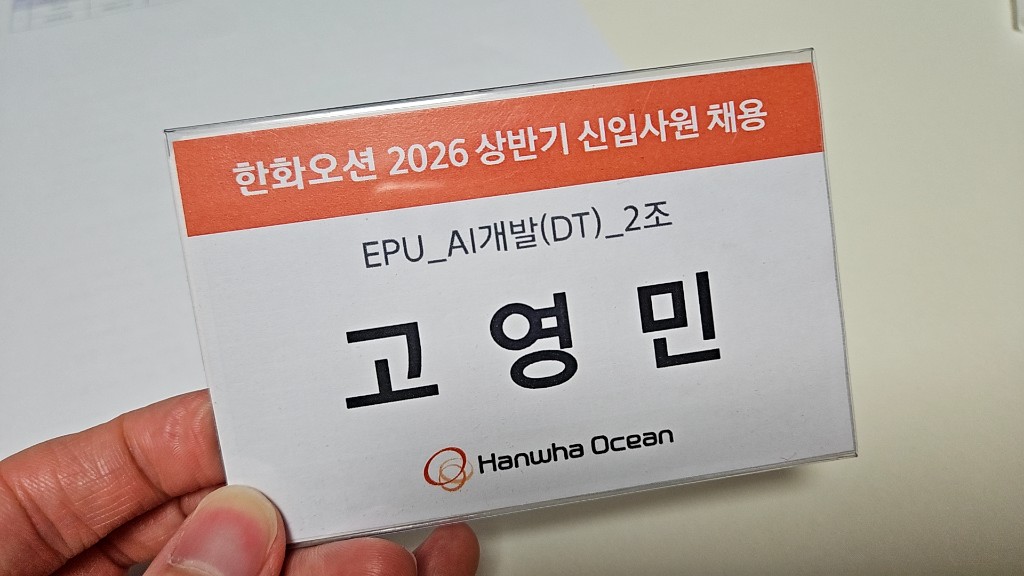
Hanwha Ocean 2026 new-grad hiring: EPU_AI Development (DT) Team 2
Two things stuck with me most.
First, consistency in translating experience into "corporate language." Instead of listing UGV-MON, LG Aimers, and LLM experience as-is, I re-connected each one to the shipbuilding/offshore AX problems Hanwha Ocean needs to solve. The same experience persuades very differently once it's translated into the role's language.
Second, the attitude to endure a waitlist. While waiting on an outcome I couldn't control, all I could do was keep preparing the next thing, and that wait turned into an additional offer.
I have to start learning the shipbuilding/offshore domain now. But I'll carry over the same method: turning unfamiliar field data into things people actually use by questioning, validating, and documenting.