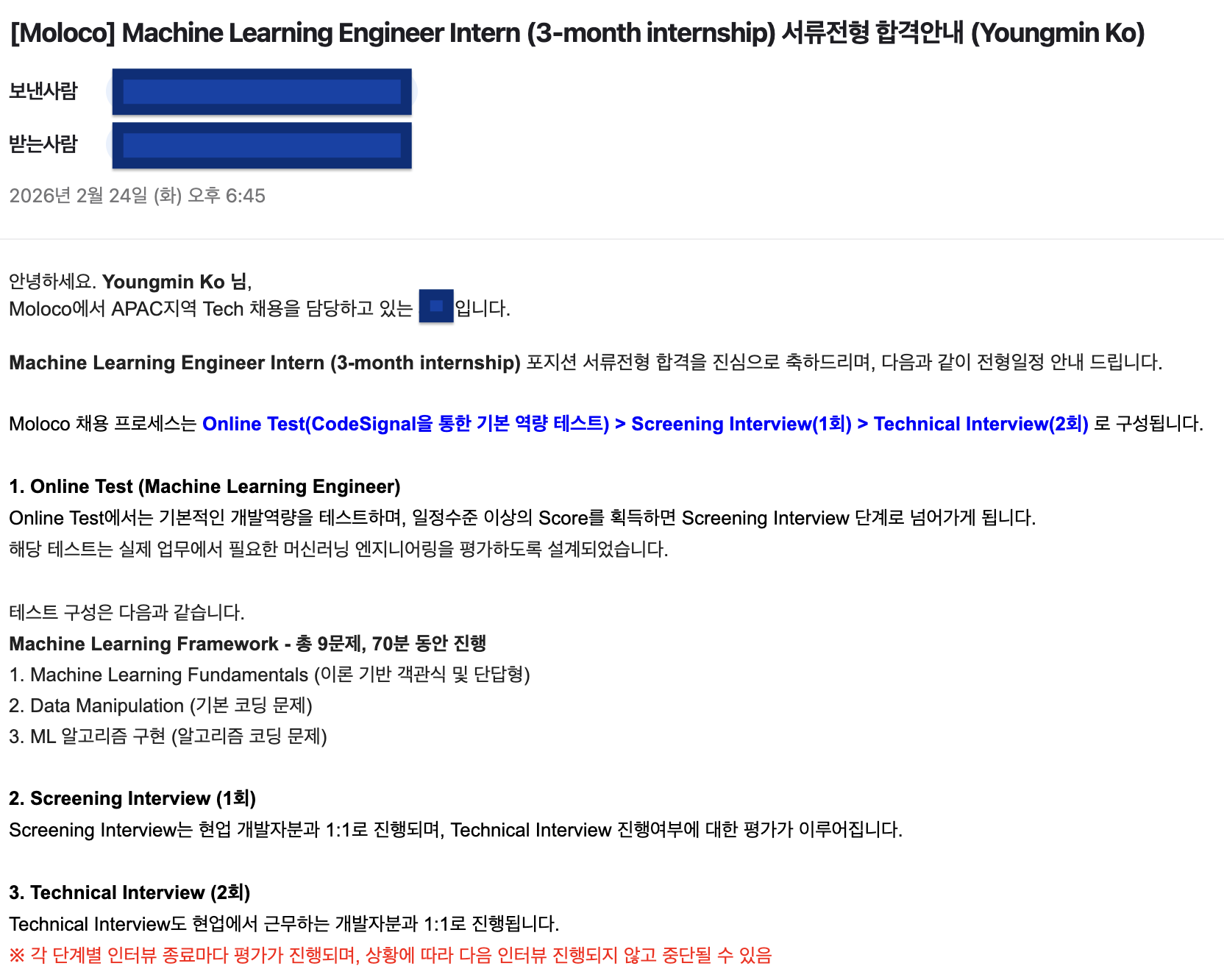
I passed the resume screen for MOLOCO's Machine Learning Engineer Intern role and took the coding test in early March. I passed it and went on to the technical interview.
The test questions stay private under the assessment rules. What follows is how I prepared, where the time actually went, and what I would tell someone preparing next.
What the test looked like
It ran on CodeSignal in three parts.
- Multiple-choice ML concepts: metrics, ensembles, dimensionality reduction, overfitting. Many questions, but quick if you have prepared.
- Compute-by-hand, answer only: simple arithmetic where decimal slips are the risk.
- Implement a function from scratch: this is where scores split. No libraries; you write the algorithm yourself.
Time allocation mattered most. Clear the multiple choice fast and save as much time as possible for implementation.
How I prepared
- Concepts as decision rules, not definitions. Grouping ideas by when to use them (labels or no labels, parallel or sequential) made the multiple choice fast.
- Common algorithms written once without libraries. Clustering, ensemble voting, string scanning: things I normally call in one line are slower to write by hand than you expect.
- Test cases first. Empty input, all-equal input, and ties, written down before the code.
What decided the score: edge cases
All three implementation problems were tricky in the same place. Normal inputs are easy; edge cases fail silently.
- Ties. One character, > versus >=, decides whether the leftmost or rightmost candidate wins. Reading the condition to the end matters.
- An empty group. In an iterative algorithm, the moment a group gets no members you cannot take its mean and the array shape breaks. If you have not decided how to handle it, you find out mid-test. I did.
- Return types. Correct values in the wrong type broke the next step.
If I prepared again
- One day on concepts, summarized as a single decision table.
- Five core algorithms written from scratch, each with three edge cases listed first.
- Before each implementation problem, run "empty, tied, all equal" in your head once.
The gap between knowing an algorithm and implementing it correctly was edge cases.